





Namibia has taken a decisive step towards strengthening its national cybersecurity posture with the launch of its National Cybersecurity Incident Management Guidelines (2026), a milestone that reflects both national urgency and the tangible impact of African regulatory collaboration under iPRIS.
This achievement traces back to the fourth iPRIS cohort, where Namibia’s delegation identified critical cybersecurity gaps and committed to addressing them through a Change Initiative that has now moved from concept to implementation. This fourth cohort was an all-female delegation, consisting of Ella-Betty Chapoto, Mirjam Mungungu, Magano Katoole, and Charley Cloete.

Read more about the fourth cohort’s discussions after their full iPRIS cycle here
A clear problem, a targeted response
During their first engagement in Sweden, the Namibia team, now iPRIS alumni, highlighted a rapidly evolving threat landscape.
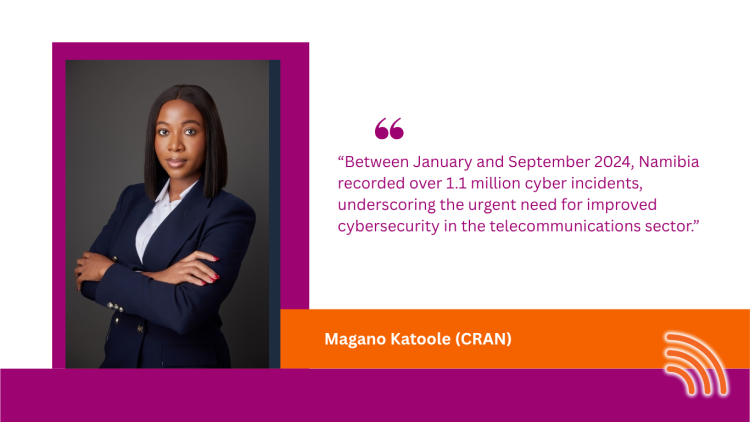
The scale of these incidents pointed to a structural gap: while digital adoption was accelerating, coordinated national mechanisms for managing cyber incidents remained underdeveloped. In response, the team advanced a Change Initiative focused on strengthening incident response frameworks, laying the foundation for what would become the national guidelines.
Building a cyber-resilient ecosystem
The launch of the guidelines marks a shift from reactive responses to a coordinated, risk-based national cybersecurity approach. Developed by the Communications Regulatory Authority of Namibia (CRAN) in collaboration with the Namibia Cybersecurity Incident Response Team (NAM-CSIRT), the guidelines provide:
- A national framework for detecting, reporting, and responding to cyber incidents
- Clear protocols for coordination across government, private sector, and critical infrastructure operators
- Standardised processes for incident management, communication, and recovery
- A foundation for continuous improvement and adaptive response in a rapidly evolving threat landscape
Importantly, the guidelines emphasise that cybersecurity is not a standalone technical function, but a shared responsibility across institutions and individuals. As highlighted during the launch:
Cyber threats are not hypothetical; they are real, evolving, and require continuous preparedness, coordination, and learning.
From policy gaps to practical tools
In the absence of a fully enacted cybersecurity law, the guidelines serve as a critical operational bridge, enabling institutions to act now rather than wait for legislation. They introduce practical mechanisms such as:
- Defined incident response lifecycles (from detection to recovery and post-incident learning)
- Mandatory and recommended incident reporting timelines
- Structured roles and responsibilities across organisations
- Emphasis on cyber hygiene, staff training, and awareness
Data-driven urgency and real-world scenarios
The launch also reinforced the urgency of action with concrete national data and examples:
- Namibia experienced multiple ransomware attacks within the first months of the year, averaging nearly one per month
- Common vulnerabilities include misconfigured systems, outdated software, and weak access controls
- Cyber risks increasingly extend through third-party and supply chain dependencies
To translate policy into practice, the event included live simulations demonstrating real-world threats such as:
- Phishing and social engineering attacks
- Fraud through remote access tools
- Risks associated with public Wi-Fi and digital behaviour
These examples underscored a central message: cybersecurity resilience depends on preparedness, awareness, and rapid response, not prevention alone.
Strengthening regional and global cooperation
The guidelines also position Namibia within a broader ecosystem of regional and international collaboration.
They align with and leverage cooperation through platforms such as:
- SADC cybersecurity frameworks
- AFRICA CERT and international incident response networks
- Global standards including ISO and NIST frameworks
This reflects a core iPRIS principle: cross-border collaboration is essential, as cyber threats do not respect national boundaries.
iPRIS in action: From discussions to national impact
The Namibia case demonstrates how iPRIS moves beyond knowledge exchange to institutional transformation.
What began as a cohort discussion in Stockholm and Swakopmund has resulted in:
- A nationally adopted cybersecurity framework
- Strengthened institutional coordination through NAM-CSIRT
- Increased national awareness and stakeholder engagement
- A scalable model for other regulators facing similar challenges
The initiative highlights the value of peer learning and structured change processes in enabling regulators to respond to complex, fast-evolving challenges. While the guidelines mark significant progress, they are designed as a living framework, continuously evolving alongside emerging threats, technologies, and national priorities.
With ongoing efforts to advance cybersecurity legislation, expand capacity building, and strengthen coordination, Namibia is positioning itself for a more secure and resilient digital future. As the iPRIS journey continues, this milestone stands as a clear example of what is possible when insight, collaboration, and implementation come together.
Watch highlights from the fourth iPRIS cohort below
iPRIS is coordinated and implemented by SPIDER in strategic and technical partnership with the Swedish Post and Telecom Authority (PTS) and Institut luxembourgeois de régulation (ILR), as well as ARTAC, CRASA, EACO, and WATRA.
iPRIS is funded by the European Union, Sweden, and Luxembourg as part of the Team Europe Initiative “D4D for Digital Economy and Society in Sub-Saharan Africa” (Code: 001).