



Enabling meaningful and inclusive connectivity across Africa is at the heart of 56 country-led Change Initiatives supported by iPRIS. As the project marks three years and launches its tenth cohort, regulatory institutions from 34 African countries have engaged in peer-to-peer exchange to turn shared knowledge into practical changes that respond to people’s needs.
Telecommunications regulators from six African countries — Kenya, Nigeria, The Gambia, Uganda, Zambia and Lesotho — will convene in Sweden from 9th to 26 November 2026 for the tenth cohort of the ICT Policy and Regulation – Institutional Strengthening (iPRIS) project, a multi-partner initiative co-funded by the European Union, Sweden and Luxembourg. The November 2026 cycle will mark the tenth cohort of the iPRIS project and three years of peer to peer knowledge sharing that has so far involved 34 African countries and resulted in 56 country-led regulatory Change Initiatives. Through reciprocal learning, telecommunications and international development experts share experiences, examine approaches to resilience developed in different markets and adapt relevant practices to their national priorities.
The participating institutions in the 10th cohort include the Communications Authority of Kenya (CA), Nigerian Communications Commission (NCC), Public Utilities Regulatory Authority (PURA) of The Gambia, Uganda Communications Commission (UCC), Zambia Information and Communications Technology Authority (ZICTA) and Lesotho Communications Authority (LCA). New colleagues from the authorities benefit from a long standing capacity building partnership that enables sustained institutional strengthening, as institutions take part in the iPRIS project several times.
Working alongside peers from SPIDER center, the Swedish Post and Telecom Authority (PTS), Luxembourg's Institut luxembourgeois de régulation (ILR), Portugal's Autoridade Nacional de Comunicações (ANACOM), and four African regional regulatory organisations — the West Africa Telecommunications Regulators Assembly (WATRA), East African Communications Organisation (EACO), Communications Regulators' Association of Southern Africa (CRASA) and the Assemblée des Régulateurs Télécoms de l'Afrique Centrale (ARTAC) experts will engage in peer-to-peer knowledge exchange to strengthen intra-African and Africa–EU regulatory cooperation, share practical experiences and address evolving regulatory challenges, contributing to meaningful global connectivity, digital cooperation and inclusive digital transformation.
Through its multilingual approach, encompassing English, French and Portuguese, the iPRIS project facilitates knowledge exchange among regulatory institutions across different linguistic regions of Africa, promoting inclusive participation, cross-regional learning and stronger institutional partnerships. While the tenth cohort will be conducted in English, the wider project supports cooperation across all three language groups.
The exchange comes as African countries accelerate efforts towards the African Union's Digital Transformation Strategy for Africa 2020–2030 and the Sustainable Development Goals, with regulatory cooperation increasingly important to addressing connectivity gaps, technological change and digital inclusion. Globally, the ITU estimates that 2.2 billion people remained offline in 2025, while mobile broadband services were still unaffordable in around 60 per cent of low- and middle-income countries.
“Since 2023, the iPRIS project has brought together regulatory institutions from over 30 African countries. What has been especially rewarding is seeing learning move in both directions, with African and European regulators drawing on one another’s experience. Equally valuable is the exchange among African institutions, where colleagues share practical tools and discuss what has worked, what has not and how those lessons can inform their own regulatory approaches,” Prof. Caroline Wamala-Larsson, Director of SPIDER.

How Change Initiatives Are Shaping Africa's Digital Future
 Experts from ICTA Mauritius and SPIDER in a peer-to-peer learning session during the 8th iPRIS cohort’s follow-up phase.
At the heart of the iPRIS project is a peer-to-peer model that connects African national telecommunications regulators, regional regulatory organisations and European institutions sharing experiences and adapting lessons from diverse regulatory environments. Framing these opportunities and challenges in a wider digital inclusion discourse ensures focus on how digital development benefits people and the planet. Rather than promoting uniform solutions, the project enables regulators to compare experiences, learn from diverse approaches beyond their borders and regions and adapt relevant practices to their respective markets.
This cooperation is translated into country-led Change Initiatives, through which participating institutions identify regulatory priorities and develop practical responses to challenges within their jurisdictions. Across previous cohorts, participating regulators have worked on initiatives addressing cybersecurity, spectrum management, consumer protection, digital inclusion and emerging technologies.
Southern Africa — Namibia’s coordinated response to cyber incidents
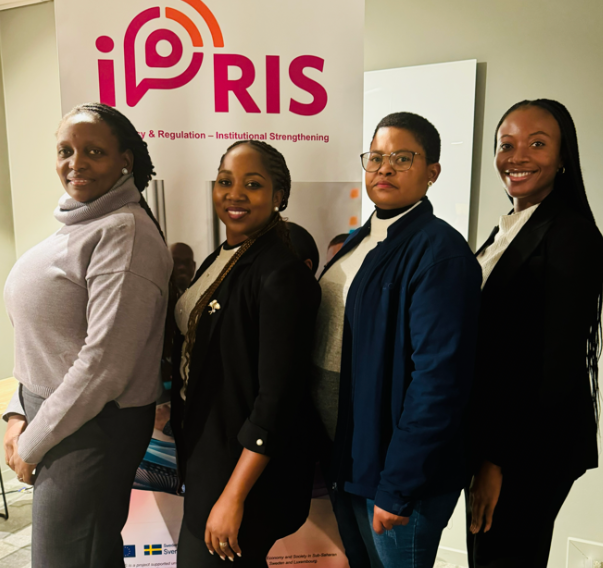 CRAN experts of the 4th iPRIS cohort
Namibia has launched National Cybersecurity Incident Management Guidelines following work advanced through its iPRIS Change Initiative. Developed by the Communications Regulatory Authority of Namibia (CRAN) with the Namibia Cybersecurity Incident Response Team (NAM-CSIRT), the guidelines define reporting timelines and responsibilities across government, businesses and critical infrastructure operators. They cover detection, response, recovery and post-incident learning, alongside staff training and awareness. The guidelines provide practical tools for coordinated action while Namibia advances its cybersecurity legislation, supporting continuity of the digital services people rely on.
East Africa — Tanzania’s digital accessibility initiative
 TCRA experts of the 8th iPRIS cohort
The Tanzania Communications Regulatory Authority (TCRA) is improving its website’s accessibility through an ongoing iPRIS Change Initiative integrating assistive technologies. Engagement with disability associations has helped identify barriers, while the Tanzania Bureau of Standards has recognised efforts to implement the national ICT accessibility standard. Reported as 80 per cent complete in October 2026, the initiative is drawing on regulatory exchange to strengthen accessibility assessment and benchmarking, helping make digital information and services more usable for persons with disabilities.
Southern Africa — Zimbabwe’s cybersecurity framework for critical infrastructure

POTRAZ experts of the 8th iPRIS cohort
The Postal and Telecommunications Regulatory Authority of Zimbabwe (POTRAZ) is developing a cybersecurity framework for critical infrastructure through its ongoing iPRIS Change Initiative. The framework addresses organisational practices and accountability alongside technical safeguards, an approach highlighted by Stockholm University’s Prof. Fredrik Blix during the regulatory exchange. The work also considers cybersecurity and privacy as services such as healthcare become increasingly digital, aiming to strengthen essential systems and protect the sensitive information people entrust to them.
These experiences illustrate how international and regulatory cooperation can extend beyond training and technical exchange to inform institutional practice and national regulatory priorities.
“Equally important is the ability to learn from one another. When regulators share evidence, implementation experiences and successful policy approaches, countries can adapt proven solutions rather than starting from scratch. Better regulatory intelligence ultimately leads to better regulatory decisions,” said Engr. Aliyu Yusuf Aboki, Executive Secretary of the West Africa Telecommunications Regulators Assembly (WATRA).

Strengthening Africa–EU regulatory cooperation
The tenth cohort will bring together regulatory experts from Africa and the EU to exchange experiences on broadband deployment, numbering and addressing, competition regulation, consumer protection, secure communications and emerging regulatory issues. Participants will develop and refine their Change Initiatives through technical discussions, institutional exchanges and sessions addressing project management and diversity, equity and inclusion.
The project places peer-to-peer learning and mutual exchange at its core, bringing together African and European regulators, including PTS, SPIDER at Stockholm University , WATRA, EACO and CRASA, to share experiences, practical approaches and lessons in addressing common digital regulatory challenges. Dedicated sessions with PTS will provide insights into Sweden’s regulatory experience, including its engagement within the broader European Union and the Body of European Regulators for Electronic Communications (BEREC). Technical visits to industry partners will further enrich the peer-to-peer exchange by offering practical industry perspectives on telecommunications infrastructure, innovation and emerging technologies. These engagements will foster reciprocal learning, strengthen cross-regional regulatory cooperation and provide opportunities to adapt shared experiences and lessons to different national and regional contexts.
Roadmap to African Union's Digital Transformation Strategy for Africa
The tenth cohort also marks a milestone in iPRIS's contribution to the African Union's Digital Transformation Strategy for Africa 2020–2030, which identifies enabling policy and regulatory frameworks, digital infrastructure, digital skills and innovation as foundations for inclusive digital transformation. Building on three years of cooperation involving 34 African countries and 56 country-led Change Initiatives, iPRIS expects to have engaged 39 African countries and reached over 200 telecom regulators by early 2027, with 5 lusophone countries joining in February: Mozambique, Angola, Guinea-Bissau, Cabo Verde and São Tomé and Príncipe. The milestone will be commemorated through iPRIS @10, a campaign highlighting institutional experiences, peer learning, partnerships and progress across the project's first ten cohorts.
About the iPRIS project
The ICT Policy and Regulation – Institutional Strengthening (iPRIS) project supports peer-to-peer knowledge exchange, institutional strengthening and regulatory cooperation between African and EU telecommunications institutions.
The project is coordinated and implemented by SPIDER Center in strategic and technical partnership with the Swedish Post and Telecom Authority (PTS), Luxembourg's Institut luxembourgeois de régulation (ILR), Portugal's Autoridade Nacional de Comunicações (ANACOM), and the African regional regulatory organisations ARTAC, CRASA, EACO and WATRA.
The iPRIS project is co-funded by the European Union, Sweden, Luxembourg and Portugal as part of the Team Europe Initiative "D4D for Digital Economy and Society in Sub-Saharan Africa."